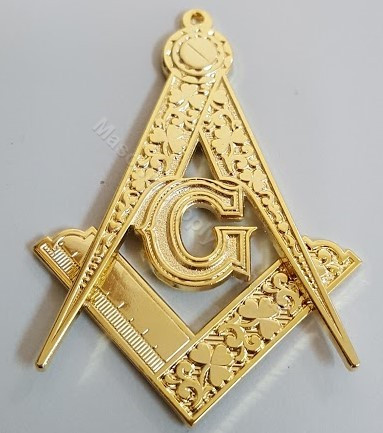
Walk through almost any older cemetery in North America and you'll find Masonic symbols carved into headstones. For family historians they are valuable clues: a single emblem can tell you that an ancestor belonged to a lodge, and sometimes which other bodies he joined. Here's how to read the most common ones.
Square and Compasses
The most common Masonic gravestone symbol is the Square and Compasses, often with a G in the center. It indicates the person was a Freemason, a member of a Craft (Blue) lodge. This is your starting point: look for his lodge in local records.
Past Master emblem
The compasses on a quarter circle with a sun, or in English-style jurisdictions a square with a geometric diagram, indicates a Past Master, a Brother who served as Worshipful Master of his lodge.
Royal Arch
A keystone, often with letters around it, or a triple tau (three T shapes joined) points to the Royal Arch, part of the York Rite.
Knights Templar
A cross and crown, sometimes with the motto In Hoc Signo Vinces, indicates the Knights Templar, a Christian order within the York Rite.
Scottish Rite
A double-headed eagle, often with the number 32 or 33, indicates the Scottish Rite. A 33 marks the honorary 33rd degree, conferred on relatively few Masons.
Shrine
A scimitar with a crescent and star, sometimes with a sphinx's head, marks a Shriner. He would also have been a Master Mason.
Order of the Eastern Star
A five-pointed star, usually pointing downward and often with a different symbol in each point, belongs to the Order of the Eastern Star. Its members include women with Masonic connections as well as Master Masons, so this symbol often appears on a woman's grave.
Look-alikes that aren't Masonic
- Three linked rings (often with letters F, L, T) belong to the Independent Order of Odd Fellows.
- Shield and helmet emblems may belong to the Knights of Pythias.
- Stylized hands, anchors or wreaths are general memorial symbols.
Don't record an ancestor as a Mason on the strength of a look-alike. Check the details.
Recording what you find
- Photograph the stone in low, angled light, which makes carving easier to read.
- Note the exact symbol, any letters or numbers, and the cemetery location.
- Never use chalk, shaving cream or wire brushes on old stones. They cause damage.
Next steps
A Masonic symbol tells you where to look next. Our main Masonic genealogy guide explains how to contact Grand Lodges and search membership records. If the family still has his regalia, an apron case keeps it safe while you research.